Thursday, October 11, 2012

Fashion on Wheels

What is working at our daily jobs if not an opportunity for us to look fabulous?  Yes, there is that question of earning a living and feeling fulfilled, but aside from all that, it gives us the chance to adorn our bodies in clothing that makes us feel powerful, important, or at least interesting.  If it weren’t for our daily occupations, how many of us would forget to change out of the appalling but comfortable sweatpants and shapeless college-era tees we prefer to sport around the house?

Yes, work is an excuse to look sharp.  But looking good each day while riding a bicycle to work is a separate challenge, one that I recently discovered is more often than not forsaken by my fellow bike commuters.  One crisp,  sunny September afternoon, I left work early and biked to the east side of the Hawthorne Bridge to conduct a fashion study of Portland cyclists.  I parked my faithful two-wheeled friend alongside the bike path and wedged my $160 Dansko platform clogs into the V of the metal fencing, hoisting myself up onto the broad, flat steel rail above. I swung my purple tights-clad thigh over the top.  After a few brief moments of awkwardness – I’m sure no one was paying attention – I managed to turn around, arrange my silk, black-polka-dot skirt around my knees and cross my legs in modest reporter fashion.  My view as I balanced on the fence rail encompassed the entire south bikeway looking west – the perfect data collection point for my research.

It was 4:45 pm.  I would be able to evaluate and tally the biking wardrobe of every east-bound commuter coming at me from this strategic perch.

I pulled my pen and notepad out from my handmade studded pleather backpack, and tucked an escaping wisp of hair back under the cute, flower-print Nutcase helmet I still wore.  It matched my pink Anthropologie blouse and added just the right aura of local hip chic to the otherwise client-appropriate outfit I had picked for work that morning.

Hardly a minute passed before I was called into action by a small pack of riders approaching from the SW 2nd Avenue bridge ramp.  My plan was to take a one-hour sample of cyclists, counting and classifying their attire as they made their daily commute home after work.  The timeframe, from 4:45 to 5:45, would capture slackers who sneak out of work early (like me) and give folks a chance to change after work if that is their thing.  The first small group of riders consisted mainly of men in jeans and T-shirts.  One rider wore logo-emblazoned tour gear a la Lance Armstrong.  There were two women in black elastane biking pants.

For the next hour, cyclists came at me in spurts or in long continuous lines of twos and threes jockeying for the pole position going up the slight incline to SE Hawthorne Blvd.  At times, my tally marks couldn’t keep up with them all.  The sheer volume of bike riders was impressive.  After the first half hour, I had put pen to paper 187 times.  I ride with this enormous pack every day – I line up behind them in the green box at the MLK traffic light, I feel their wind as they zip past me on the uphill at SE Clinton Street.  But witnessing them now, each following one after the other like a rolling ant parade, drove home how robust this bike-centered life is here in Portland.

I have to admit I was a little surprised at what they wore.

The first 15 minutes brought almost all young people – in jeans.  I personally never wear jeans to work.  I rarely even wear them at home, preferring slouch-wear, pajamas or a pretty sundress.  It dawned on me that this must be the student contingent.  The servers from Starbucks and Pizzicato had punched out.  The last class of the day at PSU had finished up.  These were the pre-professionals, and jeans serve as everyday wear that is just as appropriate and convenient on the seat of a bike as in the seat of a classroom chair.  Jeans dominated my non-scientific study – 35 riders wore them – until 5:00 pm, and by the end of the hour, I had counted 183 jeans-wearers; 119 men and 64 women. Obviously, the ‘Portland casual’ look played heavily outside of the classroom too, accounting for 23% of the cyclists that hour.


The second noticeable wave of fashion was the shorts and T-shirts set.  Mostly men, these riders swarmed a little later, between 5:10 and 5:30.  I imagined office workers changing out of their slacks and dress shirts in office bathroom stalls.  They donned leftover weekend clothes – whatever had been tossed on the bedroom floor Sunday night: multi-pocketed cargo shorts, barbeque-stained T-shirts, an occasional button up madras shirt – and were now sweating in them.  In this same category, I lumped those who wore athletic attire of any sort.  Women more often than men wore windproof, ripstop biking pants, stretch pants or full-length athletic tights.  My favorite rider in this category wore super short blue running shorts, but kept his shirt and tie from the office.  (Apparently, he only sweats from the waist down.)  This sexy combination caused me to stare, and he waved at me, smiling big. I watched his royal blue tie flap in the wind and his nicely muscled thighs pump the pedals.  The distraction made me miss the next five riders.

As should be expected, athletic gear and shorts dominated the hour with 46% of riders, 260 men and 115 women choosing them as the appropriate attire for a tranquil September afternoon ride home.
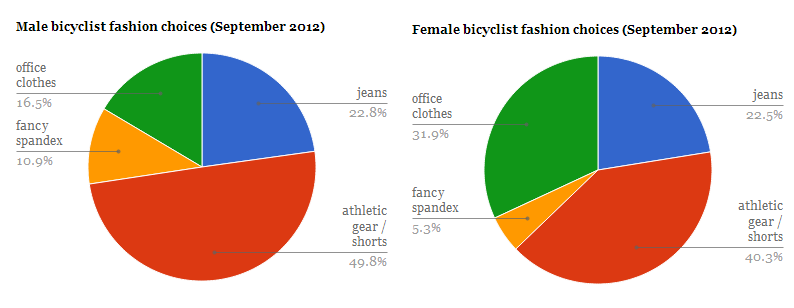


Interspersed among these groups was the occasional pro-biker wannabe.  These riders looked serious; perhaps they live in Gresham, from the built-for-distance, multi-colored spandex shorts they wore.  Their matching singlets, emblazoned with sponsor names and banana pockets, frequently camouflaged middle-aged paunches.  These riders almost all carried panniers on their bikes instead of backpacks.  Like I said – serious!  Fifty-seven men and 15 women considered their ride grueling enough to wear only the finest in bike gear. As a fashion category, this group had a poor showing at only 9%.  A mere 72 riders emulated the style of the pros.  Could the recent de-throning of the allegedly drug-addled Tour legend, Armstrong, have something to do with these paltry numbers?

My favorite category was the well-dressed biker.  These were people who, with the easy addition of a pant-leg strap and the loosening of the tie, transitioned from high-powered client meetings to high-speed escapades down the Eastbank Esplanade in seconds flat.  Men wore dress shirts and ties; women wore slacks and flats.  There were 86 men who did nothing more than roll up a pants leg and swing it over their bike to get on the road.  Surprisingly, this is the only category where women out-performed men.  Ninety-one females of all shapes and sizes did away with the fuss and bother of packing a change of clothes for their commute. They wore what could be considered office clothing, including simple skirts, boots, slacks, penny-loafers, sandals and blouses.  My favorite business-attire rider, not unlike my favorite blue-shorts-and-tie man, demonstrated the value of mixing genres.  She wore a tight little black skirt and an elegant blouse, but underneath she had sensibly chosen hot pink lycra shorts that flashed with every turn of the crankshaft.  In my one hour sample, I observed 146 people (22%) who found it unnecessary to change their clothes before their commute.  Like me, they probably ride a little slower than the rest so as not to muss their dry-clean-only items.

During this study, I saw a man covered in bags full of plastic bags, a women in her hospital scrubs, a grown man riding a scooter in shirtsleeves and tie, a giant tricycle carrying mom, dad and child, two shirtless men, and a smattering of children riding behind their parents on variations of bicycles built for two.  I learned that men ride more than women, at a rate of almost 2 to 1. I viewed a wide variety of work and fitness attire and inferred that those who changed into different clothing for their commute, about 54%, think of it as an athletic activity, while the remaining 46% don’t necessarily. Overall, I counted 807 thin, fat, tall, short, brown, white, hairy, bald, young and old people as they powered themselves efficiently and cleanly across our famously bike-friendly bridge.  That averages 13 people per minute.  Most of them wore shorts – and a smile.

I hopped down from my observation deck and stowed my research tools back in my cute little backpack.  I have to admit, I was a little disappointed with the results.  I was looking for fashion statements, riders who thumbed their noses at the concept that cycling and looking great are like oil and water. I was hoping to see patent-leather pumps and floral-print peasant skirts; pink ruffles with matching thigh-highs, Brooks Brothers jackets, suspenders and spiffy Dolce and Gabbana silk ties.  Apparently, Portlanders are a little too practical – or they sweat more than I do.

So, with a sigh, I mounted my two-wheeler and merged with the still-heavy traffic streaming out of downtown, taking my familiar place amongst my pack.  With my black polka-dots, my bright, flouncy, lace-trimmed blouse and my purple tights, I headed for home in the slow lane, a single point of eye-catching fabulousness in the thick of the crowd.

Sunday, September 30, 2012

Love


Love takes many forms.  

There is puppy love – the shy, confused kind you feel at age 5 when a tall, sun-kissed-blonde, 13-year old named Wilber from across the street stoops over to pat your curls and tie your shoe.  “Aren’t you a sweet potato pie?” he asks, dimples in full relief as he grins at you, half boy, half man.  Those long-ago five minutes when you first discovered - up close - how alluring shirtless summer skin can be as it brushes against your pudgy cheek.  Oh, the flutter that brief attention causes in your skinny chest.  Like a thin, warm cinder, the moment glows softly over the following months and years.  You watch for Wilber’s entrances and exits from across the forbidden barrier of the street, hoping he will remember that you are his sweet potato pie.  Unknowingly, Wilber earns your secret baby affections from afar, cluelessly enchanting you with his bent-legged cartwheels, his tree-climbing skills and the freewheeling laughter that rings out from high-up branches.  Puppy love’s innocent affection, its wide-eyed awe and inevitable impossibility introduce us to the world of romantic attraction.

Then there is the other kind of puppy love – love for actual puppies.  This puppy love, very different from the other kind, pangs sweetly with a sappy tenderheartedness.  It suffuses your body when you spy that one, dark-eyed ball of fur that seems to love only you.  His heart-rending neediness and his unwavering, wagging yearning to be close to you strikes a chord on your heartstrings.  He gleefully submits to you, laying himself out vulnerably as if he knows you alone are innately unable to harm him.  To him, you are all-powerful, all-loving.  You are so stricken with him that you sign up to feed, walk and care for this living creature for the next 20 years.  He seems perfectly suited to please you, from his delightful little kisses to the squirming of his malleable little puppy body.  You take him home, driving with him wrapped inside your jacket because you can’t bear to hear him cry to be apart from you.  He is your new best-friend-for-life. 

Months later, when that fuzzy, warm ball of fur plops down for a nap on your foot, round belly still protruding pinkly like a baby, you melt anew with puppy love.  There is something about the wet nose nuzzling your hand, begging for the hundredth scratch behind the ears, that draws out the sweetheart in you.  When you return from a short trip to the store, he senses your approach from a block away.  His exuberant ecstasy causes his whole body to quake and he wets himself with glee at the joy of simply being in your presence again.  This undying joy cements his place in your heart.  Just by being yourself, you earn his worship.  This kind of puppy love is instantly rewarding.  It converts you from an underpaid foot soldier on the treadmill of adulthood to an all-powerful goddess, bestowing happiness with a gentle gesture and a smile.       

Both kinds of puppy love, however, grow older.  Wilber grows spotty facial hair and starts hanging out on his front porch drinking beer with scruffy-looking n’ere-do-wells.  His crunched up beer cans litter the sidewalk. He burps loudly and plays guitar badly.  His beat-up rust-bucket squeals annoyingly as he skids down the street at 2 in the morning. 

Your fuzzy, four-legged friend also ages.  He starts chewing shoes…and furniture and records and $90 work slacks. He grows fat in a way that isn’t so cute anymore.  Pooch develops allergies.  He sheds.  The glossy fur you loved to pet comes out in handfuls and forms tumbleweeds that tickle your nose and accumulate in the corners of your living room.  He licks his balls then turns to lick your face or steal a bite of your toast.  That cute little puppy voice becomes an incessant barking that annoys the neighbors and causes disharmony on the once-friendly block. 

Eventually, puppy love dissipates and disappears.  But at least for Fido, you stick with it (Wilber can take care of himself).  Year after year, you continue to feed and walk and clean up after your aging sidekick.  You still play tug-o-war when he feels chipper.  He still lies on your foot and nudges your hand, asking for affection.  And you still give it.  The many years of happy companionship he has brought you with his undying devotion deserve as much.  Puppy love has turned into old-dog care and maintenance.

There are many stages of love. 

There is first love, when you have passed through puberty successfully and are surprised to discover that a male can be interesting and funny, and interested in you.  You share a chance conversation after softball practice with the coach’s son.  He laughs at your jokes.  He looks you in the eyes and doesn’t look away, eager to know more about you.  He asks you questions and listens to the answers.  You mention a song you like; he asks if you would copy it for him.  Mutual interest emboldens both of you to seek each other out at gatherings and think up excuses to call each other on the phone.  You spend time together, away from your friends.  You lay side by side on the grass talking for hours.  He turns to hear you better.  You turn to see him as he talks.  Your faces are very close.  So close, in fact that you feel like you should stop talking, but talking allows your lips to move, distracting you from the fact that your knees are touching his knees and your belly is growing warmer from his surprising body heat, co-mingling with yours like his earthy scent and the fresh grass smell beneath your cheek.  Your words grow laconic and pointless, their only purpose remains to prove that you two are still just talking.  Somehow your lips are forming words and simultaneously drawing closer to his.  Sentences come out as a jumble of unrelated words:  “Pineapples……hang-glide……predator”.   Your brain is unable to keep up the charade convincingly as the ‘P’ sound brings skin to skin, a gentle push, and you give up the farce, reaching the rest of your mouth out towards his in an innocent first kiss.

First love is ill-fated, like Romeo and Juliet.  Soon jealousy overtakes you.  You see him, bolstered by the new confidence your affections have given him, flirting with other girls, trying out his appeal on a larger audience.  The recent feeling of walking on clouds becomes one of being mired in the sticky complexities of pride and selfishness.  What once was uplifting is oppressive, sucking greedily at your time and emotions; combative, boxing your heart with heavy, clumsy punches; obfuscated, all but forgotten beneath the thorny brambles of teenagers struggling for self-esteem and identity.  Of course, you are young and fickle, so it ends quickly, and badly, bringing new sensations of humiliation, failure and a guilty longing for the dizzying perfection shared only weeks earlier.  You yearn for that first pure and innocent moment in the grass as you fume over the new girl – outward proof of his newly bolstered sense of self-worth and your worthlessness.

You get over it, and move on eventually.  After first love, comes second love.  Second love turns out to be an unsupportable infatuation, and third love was really only about his body in the end.  By the time fourth love tries to sneak into your life, you have graduated from soft, sweet kisses to all that there is to know about men and women together in the dark.  You are an adult, you think you are savvy about love.  You know how to distinguish the butterfly feelings in your chest from a solid sense of connection.  You are able to put aside the fancy dinners out, the cunnilingus and the impromptu skinny dipping in the park to evaluate whether this person can help you achieve your life goals.  Love takes on more responsibility.  You are starting to realize that even a solid connection isn’t enough.  Is this the person you can build your dream with?  Will you become a better person with him at your side?  Can you trust him with decisions that would change your life?  Can you, indeed, trust him with your life?

When the answers to these questions are all affirmative, you realize that this is a new kind of love - a somewhat calculated love, functional and anchored by shared values.  Ideas about politics, money, children and lifestyle weigh more heavily on the scale than you ever thought they would.  This love has a checklist attached:  Does he have a job?  Does he do what he says he is going to do?  Does he treat his mother with respect?  This fourth love is the marrying kind.  As dry as it sounds, it has to pass the practicality test.  But yet it is founded on mutual affection and admiration.  In fact, shared practicalities open up a new way to realize affection and respect, which in turn translates into a new and different way of looking at love, one that is there for the long haul.

Love feels good.

The love a mother feels for her child might be the sweetest love.  As your wee lass nurses, suckling on your warm flesh, she gazes up into your face as if you are the sun and the moon to her.  She studies and learns every curve of your face.  Her wide open eyes adore you and absorb you as if you were the milk flowing into her mouth.  In fact, as far as she can tell, you are the milk and the milk is you.  You are the satisfied feeling in her stomach and that feeling is you.  Little warm hands clutch at your breast, her eager, heart-shaped mouth searches for the source of those good feelings.  And you are so proud and pleased to be able to give it to her, to supply her with what she needs, from food, to warmth to that gentle rocking motion new parents adopt whenever they are standing still.  Her desire for you, unembarrassed, unprotected, simple and needy, ignites a love more intimate and breathtaking than carnal love.  The sight of her or the sound of her plaintive whimper feeds your craving to be of service, opening the milk gates without warning.  Being so important and so rewarded, as she smiles up at you, nipple still clutched in her toothless gums, stirs a biological love, both physical and emotional.

Love changes over time.

Husbands lose their hair and stop rubbing your feet when you get home from work.  Babies mature into independent, sassy, teenage daughters, refusing your hugs and kisses and walking five paces behind you to avoid embarrassment. You slack off in your efforts to please your family, settling into a maintenance state of simply not-displeasing.  Formerly intense feelings of closeness and mutual adoration morph into lazy routine.  The ruts you have formed deepen as you travel along the tired old passageways in your emotional life.  Occasionally, you jump the tracks for a refreshing moment of candid mother-daughter talk or a spontaneous romantic detour with the old man.  What used to be that tickly feeling upon seeing your beloved has been replaced with the solid reassurance of new cabinets in the kitchen and the calming murmur of the faithful, still-functioning washing machine in the basement.  Your physical expressions of love are now mainly intellectual expressions of satisfaction for what you have built together.  The pride you used to feel holding your lover’s arm as you strolled down University Avenue is now a solid certainty that you are marching together toward major life milestones.  Your vision of what kind of life you wanted is unfolding as planned. 

That butterfly flutter from rubbing your lips against the sweet cherub cheek of your baby daughter is unavailable to you now.  Instead, you rely on surrogate excitement, like the endorphin rev you get in spinning class or the perfect peach cobbler found at book club.  Passion and adoration for your partner turn to mature appreciation and, if you are lucky, familiar enjoyment.  Years of memories fill in that part of your brain that needs emotional stimulation.  You fondly reminisce about those lusty nights spent pursuing your future husband when he had a six-pack, or you joke about the ergone cycles of joy, fatigue and relief that came with herding little people from diapers, to first wobbly bike rides down the driveway, to high school proms.                    

We move through many kinds of love in our lives and share it with many different people, sometimes watching it change from one kind of love to another.  By its very definition, love is good, in all of its forms.  There is subtle love, deep love, explosive love, submitting love, motherly love, doting love, devoted love, compassionate love, responsible love, body-based love, brain-based love, sisterly love, friendly love, respecting love, love for one’s parents and love for dependent creatures of all types. 

There is one more type of love that may top them or encompass them all.  I like to call it pure love.  Pure love is a kind of love that surpasses all worldly definitions of what love can or should be.  There are no roles and no rules to this kind of love.  It sees no boundaries and no limits.  It doesn’t run out or grow stale.  It doesn’t start or stop with the vacillations of people’s life stages or their actions and behaviors.  Pure love is a feeling of affinity so deeply felt that to demonstrate it depends not on the relationship between the one who loves and her beloved, but upon whatever those two people need at that particular moment in their lives.  Whatever social circumstances exist are inconsequential.  Pure love answers whatever need is there, regardless of the age, gender, relationship or history of the participants.  In a pure love relationship, we would be willing to suckle the beloved if he were a baby, kiss this same person passionately if he were a grown man, or comfort him in his sickbed if he were old and infirm.  Pure love gives what is necessary.  It molds itself into whatever form best serves its recipient.

When we love purely, we don’t care about how it looks or why we feel the way we do.  We don’t keep a tally of the pros and cons.  We don’t decide whether the recipient is deserving.  We can feel pure love for an individual - a kindred soul who connects with us on a profound level.  We can feel this deep love for groups of people, like our family, immediate or extended.  Entire communities and even nations can be the focus of pure love.  Whatever is needed from us, we give, happy to be of service to those whom we love.  Pure love can be directed toward the entire world, with all of its human and non-human inhabitants, spiritual and otherwise.  And as members of this community, we ourselves are recipients.  Indeed, the most important form of pure love is the love we feel for ourselves.  Loving ourselves without conditions or boundaries, regardless of our critical evaluation of our strengths and weaknesses, through every stage and every turn our life takes, this is a love in its highest form, a cornerstone to all other forms of love from motherly love to the love we feel for strangers in Nairobi.  It cannot be bad.   With not much more than a blind faith in this alone, we can love ourselves with such tenacity and depth that nothing can break it.

Wednesday, September 26, 2012

Brain Versus Brawn


I don’t know the characters in “Lost”.  I haven’t got a clue what “Swag” means.  I don’t know who Katniss and Peeta are.  I can’t tell Jack White from Jack Black.  Please excuse my total lack of contact with modern culture: my brain is heads-down sweaty, too busy working out to know what is going on in the outside world.  Imagine the comic-strip image of a bubble-gum-pink, bumpy mass floating inside its traditional corporeal tank of cranial fluid.  Now imagine it pumping iron, curling free weights, doing burpees on the mat, cleaning and jerking double its own weight like an Olympic weightlifter, doing upside down sit-ups from the chin-up bar.  That has been my brain for the past 4 months.  

My week begins with a grueling one-hour set of focused meditation and guided imagery.  Then it’s off to my paid job for 40 hours, followed by various daily doubles designed to build strength, flexibility and tone.  Monday nights are choir practice.  Tuesdays are Advanced Conversational Spanish.  Wednesdays bring core-strengthening imagery, positive reinforcing statements, and sometimes a little yoga to exercise the fine mental skills.  Thursdays are more Spanish.  Fridays I catch up on all of my homework in my online “Mathematical Thinking” class.  Saturday and Sunday and in between structured activities, I try to squeeze in touchy-feely time with my family – spa time for my tired noggin.  Oh, and I write every day.

My brain isn’t terribly scrawny or shrimpy.  It isn’t the 98 pound weakling on the brain playground.  In fact, my brain has been my first-string quarterback for 42 years, performing admirably under duress and sometimes pulling off feats of agility so daring and muscular that it was able to come from behind to score surprising upsets over worthy adversaries.  Like when it convinced my husband that we should take our family to Peru for 7 months.  Or when it got us out of paying for a car we had rented and subsequently damaged while on vacation in Los Angeles.  With these significant title victories and others equally as impressive, why do I insist on the punishing regimen of constant, pre-occupied mental gymnastics that denies my brain the everyday pleasures of watching on-demand “Leverage” in its jammies and chowing down on beer and nachos while listening to Nicki Minja with the rest of the conscious world?
 
It’s hard to break the news.  But lately, I have noticed my brain falling behind during warm-ups and taking extra trips to the bathroom right when the action on the field gets hot and heavy.  It isn’t putting in the effort this coach expects from the star of the team.  Its midsection, as it were, is spilling out in classic dough-boy style, muffin-topping over the uniform that we are all proud of.  But looking ‘over the hill’ is the least of its troubles.  Its speed, efficiency and accuracy have all taken hits.  The stats aren’t good.  Unfortunately, my brain is showing the classic signs of early retirement.  But I am having none of that!  I am making every effort to whip it back into shape so it will continue to do its part, providing essential support to this team as we go into our 43rd season.  Just look at the sacrifices my liver has made, especially during college.  And the lungs, breathing nothing but thin air up in the Andes.  My eyes have lost some of their keen, youthful talent, but more than make up for it in their unabashed determination to out-sparkle the competition.

“Do it for the team! Do it for the team!” my organs all chant in time as my brain pants out 20 more squat thrusts.

Because, well, if my brain really does decide to retire, to grow fat on a beach in the Bahamas with a Mai Tai in its hand, to give up this dream job as top scorer on the winningest team I have ever had the pleasure of managing, that means the end of a good run for all of us.  We depend on it.  Without our star player, this team is kaput.   

So I will continue to look for ways to beef up my reluctant brain until it shines as a crushingly brawny, sturdy, reliable version of its current self.  Be it philosophy, print-making or statistics, I will continue searching for the perfect workout that inspires my brain to fall in love again with this game called life.  Joy, determination, gusto and verve can be found face-down on the mat.  Yes, I am a hard-ass.  Drop and give me ten, brain – in Japanese!

Wednesday, July 18, 2012

Full Time, Full Life


Living is a full time job when every thought, every bite, every step you take may determine how long you live.  Only 2 years ago, I would have scoffed at the idea that a thought could win me more time on this planet, or a bite of food subtract years from my life.  Even after I discovered I had cancer, I was convinced that I had no influence over the disease.  It was pure chance and simple bad luck.  If someone would have suggested that I could influence the course of the disease, I would have responded defensively, “Don’t make me responsible for having cancer.” 

We are not to blame for having a disease, just as we are not generally at fault for getting hit by a car, for falling and breaking a leg, for having a migraine.  But we all know that decisions we make as we drive, walk along the rough mountain trail or go about our daily lives can expose us to more or less risk of these events befalling us.  The idea that you can avoid falling off a cliff by staying off of the cliff in the first place begs the obvious.  Maintaining vigilance while driving will help us swerve out of the way when another car drifts into our lane. Avoiding the triggers that bring on migraines can help us avoid the pain.  Similarly, living a healthy life helps most people avoid cancer.  Staving off death through our actions and our decisions is a realistic filter through which to view our chances at longevity.  The corollary, however, is that we can bring death closer with our actions as well.  Risky lifestyles come to mind – drug use, illegal activities, dangerous jobs.  Does this same formula apply to disease? 

Cancer, for some reason, has a stigma.  The first question a recent diagnosis of cancer evokes is often, “Do you smoke?”  People assume that cancer patients ate too much red meat, or drank too much alcohol throughout their lives.  Some  may have; but others have lived a life free from the high-risk behaviors that can predictably lead to diseases of all sorts.  In contrast, a diagnosis of Alzheimer’s disease doesn’t elicit judgments on the patient’s lifestyle choices.  For some reason, cancer seems more blame-worthy.  Yes, disease can result from lifestyle, which includes the environment in which we choose to live.  But emphasizing that as a cause feels unfair, especially to those of us who developed cancer while living a clean, healthy life.  Clearly people don’t develop diseases purposefully and consciously.  But all diseases do have a basis in the body that hosts them.  Some characteristic of the patient enables the disease to exist and to grow.  The diabetic has a susceptibility to diabetes, a person who suffers chronic infections lacks the biological formula to fend off the invading bacteria.  Even genes, combined before a person is even a person, influence our susceptibility to disease and they undoubtedly belong to each of us individually.  The diseases we develop are linked personally to who we are. 

In the end, there is a cause inside of us that is also a part of us. My body created cancer cells and didn’t kill them off like other people’s bodies do.  It is no one’s fault, but it was my body that created the disease.  It is a hard message to digest.  On the one hand, having lived a completely healthy life, there is nothing I did or didn’t do to get cancer.  I did not choose who I am at the cellular level.  On the other hand, my brain controls my body, telling it which cells to create and which cells to destroy.  I am, in a sense, in charge after all.

It may be misfortune that I was born with this brain that didn’t control its cancer-eating force of white blood cells properly, allowing errant cells to blossom into something villainous inside of me.  Bad luck to be the owner of that brain!  But there is a bright side to this understanding.  If my brain is responsible, my brain has control.  If it has control, it can change the course of the disease.

Abnormal cells develop into cancer cells in everyone throughout their lives.  Most brains recognize them as harmful and exterminate them.  My brain used to do that.  Something happened – an event, a pervasive environmental influence – and my brain got lax in its oversight.  My job now, as owner and caregiver to this brain of mine, is to teach it how to do that again. 

I tend to eye with suspicion untestable theories and beliefs that require a leap of faith.  Anything far-out or ‘cosmic’ in nature is just too existential for uber-practical me.  My natural tendency is to believe the doctors in white coats and do what is expected, what is standard in our modern American society.  In my case, it is following the recommended regimen of intravenous Irinotecan and Avastin infusions once every three weeks.  Even with these dramatic, highly-researched and proven prescriptions, my oncologist has pronounced my cancer incurable by modern methods.  After more than 50 years and millions of dollars of research, cancer still has the medical community baffled.  My doctor’s goals are to prolong my life while maintaining a high quality of life.  I share these goals, but I take them one step further.  I want to rid myself of cancer completely.  Since oncology cannot offer me a complete cure, I have to cure myself.  I have decided to take things into my own hands.  I continue to follow the recommendations of my oncologist, but his drugs are only some of the tools in my arsenal.        

Everything we see, read, and hear about cancer treatment is the result of a strong capital-centered society.  The sausage coming out of the grist makes it through the perilous process of pharmaceutical profit analysis.  The ‘machine’ sluffs off studies for remedies that fail the cost/benefit formula.  Treatments that one can find in one’s own backyard, or in the inner garden of one’s mind, can’t support the research needed to test their efficacy.  These ideas are not unworthy of research, there is simply no profitable way to market them if they did prove to deter cancer.

Some of the cancer-fighting ideas left behind, strewn across the floor in the modern medicine factory, may come across as ‘far out’.  They often involve changing the way you think, eat, and feel – altering the brain, the master of our bodies and the manager of cell activity.  We would all like to know how thinking differently can change the outcome of a Stage IV cancer diagnosis.  Without studies and statistics, we will never have the proof we need to wholeheartedly say if and how these ideas work.  Unfortunately, I literally don’t have time to wait for proof.  If I want to augment my oncologist’s standard chemical prescription, if I want to shoot for the goal of curing my cancer and not just slowing it down, I have to trust in anecdotal evidence, word of mouth and the optimistic support of non-mainstream healing practitioners.  I have to go outside my comfort zone and take a leap of faith.

I am naturally cautious.  I do not fall all over myself to try the latest fad, nor am I so wide-eyed and malleable that I leave myself vulnerable to unsavory snake–oil salesmen.  But in this quest, I have decided to leave the door open to any remedy or treatment available.  From hypnotherapy to ingesting the leaves of a sacred bush in South America, if the treatment is safe and reasonably affordable, I am willing to try it.  There is the risk that, in my search for a cure, I will waste time and money on false remedies and techniques that simply don’t work for me.  Health product salespeople, trying to make a living, may take advantage of my health situation for their own profit without any lasting benefits for me.  But how is that any different from the doctor who makes hundreds of thousands of dollars a year prescribing chemotherapy that just doesn’t work for some people?  I am ready and willing to be made a fool of in my search for the magic combination that will kick-start my immune system and succeed at grinding down the cancer tumors to harmless, dead dust, which the cleaning cells in my body will sweep away and toss out like fur balls from under the couch.  It is a small price to pay for the life that I so long to continue living.

So far, I have investigated homeopathy, hypnotherapy, relationship counseling, vitamins and supplements, naturopathic treatments, exercise, yoga, meditation, massage, physical therapy, touch therapy, sex therapy, acupuncture, hydrotherapy, diet overhauls and positive self-talk.  The only thing from that list that I haven’t now included in my life is homeopathy, which introduces small quantities of dead cancer cells and other poisonous substances into your body to elicit a protective reaction and jump-start your body’s immune response.  It sounded too dangerous, drinking snake venom and hemlock, the drug that killed Socrates.  My first reaction was, “That’s crazy!”  But that was 6 months ago.  My attitude has softened as the cancer continues to stick around.  I still could be convinced with further investigation.

Needless to say, the long list of self-prescribed ‘treatments’ I have added to my weekly regiment take time.  And time is of the essence.  My therapies equate to another full-time job, but some may look strange to observers.  Outside of the multiple appointments, it may appear that I am belly-dancing, hula hooping, listening to recordings and laying out in the sun with my teenaged kids – not persevering through unpleasant medical procedures or tortuous treatments.  That is because the prescriptions I have chosen center on the idea that I have to create an internal environment that convinces my body to work hard for my survival. 

“No more suicidal cellular laissez faire”, I tell my brain.  

My treatments focus on improving how I think, eat and feel.  I see an acupuncturist to realign my inner energies.  I meditate daily to focus my mind on healing and destroying the tumors in my body.  I work with a therapist to uncover the relationships and responsibilities that may be beating down my immune system.  My subconscious receives messages of healing and confidence from my hypnotherapist.  Every single thing I put in my mouth has an anti-cancer property, which means now I eat very selectively and supplement my diet with naturally-occurring, immune-bolstering plants, oils and herbs.  Believe it or not, I follow an extreme diet, where every bite fights cancer and I don’t miss the sugar, the red meat, the processed carbs or the milk anymore.  I am worth it.  It has its positive side effects as well – I weigh the same as I did in high school.

Moreover, my number-one prescription is to be kind to myself, to love myself, to take time for myself and to care for my body by caring for my brain.  I try to surround myself with love and joy and freedom of expression.  What does it mean to be kind to oneself?  I started with giving myself permission to do whatever it takes to survive – from sleeping late on a work day, to living as a hermit on a mountaintop in Africa.  There is no better way to prove to myself that my life is valuable than by promising myself I will sacrifice anything for it.  I try to enjoy myself every minute.  I respect myself: even during those dark moments of negativity, I recognize that those are my feelings for the moment, I accept them for what they are and then try to move back into a place of joy and love.

For a historically pragmatic person, these changes are huge.  I have tiptoed into a new way of looking at life now that it is painfully precious and precarious.  I find myself staring up to the sun on a busy street corner, open arms, feeling the healing warmth of the earth’s very own life source on my face and I am not worried about the throngs of downtown lunchers staring.  My mind has both blossomed and softened, inviting ideas and practices that 2 years ago I would have written off as quackery.  A judgmental attitude has no place here, where every minute is an opportunity to extend my life. I risk sounding existential myself when I say that I believe that finding love and applying it liberally inside and out is the foundation for my eventual cure.  It is the most important prescription of all and needs to be applied every minute of every day.  My calendar is booked!

Wednesday, July 4, 2012

Nice to Meet You


It is two a.m.  The pain in my back continues to throb as if I had withstood a clubbing by some massive, repugnant ogre in a medieval battle.  It is unlike the kind of pain I am familiar with – that of elbows to the solar plexus, sprained ankles and black eyes dished out by sturdy, thick-legged women on the rugby pitch (some of them not unlike ogres themselves).  Rugby pains are sharp and surprising.  This pain is a locked room filling slowly with murky water.  The water is too black to perceive what evil creatures might be lurking below the surface.  The fear of what lies there rivals the unpleasant sensations themselves.  It sifts through my tissues and permeates me, encompassing cell by cell in its steady, confident rise to the inevitable domination of my entire body.  I cower with my cheek up against a smooth stone wall (am I in the dungeon?), huddled for the last hour in a crouch, knees spread to accommodate the large, round incubation chamber of a small creature trying to come into this world.

My first labor went on like this for hours.  Twenty six point two of them to be exact.  After 24 hours of sleeplessness, my body burning calories at the rate of a marathon runner, my head bobbed and lolled on my neck like a dying yo-yo on a string.  My eyes rolled back in their sockets.  When the doctor visited me in my hospital room every few hours, I tried to pay attention to what were probably important instructions, but my focus wavered between dreams of sleep, the mesmerizing shiny blur flashing from her stethoscope and the sudden violent zigzag of contractions that ripped through my consciousness and stopped up my ears for 45 seconds every 2.5 minutes.  After each contraction, my chin fell to my chest again, my neck too worn out from its electrified state of rigid attention moments earlier to support the heaviness of my cranium.  I was drunk with fatigue, sleeping in one minute increments. 

The contractions had started in the late afternoon, and, as our childbirth instructor predicted, they were mild and distant.  They felt like a warm buzz, an inflammation or a stirring in my pubic bones, like they were thinking about spreading.  Once I became aware of the contractions, I knew it was time to take a nap while I still could.  But my husband, anxious to ensure he wouldn’t get stuck delivering a baby in the back seat of the Honda, insisted that we go to the hospital early.  Almost instantly upon arrival, after a particularly efficient nurse took us into a private room and stuck her finger up my vagina to see how much my cervix was dilated, they sent us away.  I wasn’t far enough along to justify taking up a hospital room and adding to their workload.  But soon the contractions were coming closer together and the pain was more noticeable.  I thought perhaps we should stay and see if they developed into something more noteworthy.   

I tried to rest, sitting in the hospital waiting room, but no position was comfortable.  I stalked the maternity hall for hours.  Contractions started coming every 7 minutes.  Then every five.  My strides downgraded to a modest walk.  My walk shriveled into short spurts of uncertain movement, followed by long pauses that had me holding onto the wall.  All of a sudden, I threw up.  Luckily, I was standing next to a janitor’s sink when the bile came bubbling up.  The nagging inflammation-feeling cracked out of its shell and tendrils of pulsing soreness crept out, sending thin, green suckers along my spine and pelvis.  The sensations thickened and grew, leafing out and climbing heartily on the now-weak trellis of my bones.  My body moved on slow-motion auto-pilot as I staggered from one patient’s door to the next.  Contractions came closer and closer. 

Finally, the nurses decided I was ready for a room.  I checked in, officially this time, but the labor didn’t progress.  The night wore on.  I wore a path in the linoleum as I circled the ward, now shuffling a paltry 12" every second.  I moved like an ailing 92 year old, hunched over, holding my back, groaning, then shuffling on in the hopes that the movement would shake the baby loose.  Soon, I was groaning and holding my back every 2.5 minutes.  The hours crawled like a ragged man in the desert, dying of thirst.  I succumbed to the hospital bed, but found no solace in the short, pain-free intervals.  Every time I would drift into blissful sleep, I would immediately awaken to the wrenching twist of muscles pulling impossibly tight, bones shifting.  Every time, I called out to my husband, the time-keeper, “Contraction!”  He got little more sleep than I did. 

Why didn’t the baby come?  My body was holding back, not ready to take the final step in this life-altering commitment my husband and I had made nine months earlier in a pre-calculated month of arduous love-making.  My mind had been willing, but now my body was rebelling.  What was there to be afraid of?

What a silly question!  There was so very much to be afraid of, from the unknown pain of delivery, to the unknown personality of the person coming to stay.  What if she didn’t like me?  What if he wasn’t what I expected?  I was growing a life that was totally independent from my own.  Giving the baby that last bit of free rein took away the control that, up until this point, I felt I had.  I had given up alcohol.  I had eaten healthy foods and exercised regularly throughout the pregnancy.  Even yesterday, I had run 2 miles to encourage my very tardy child to make her appearance before the doctor performed an intervention, scheduled for Tuesday.  All this time I had been in charge of the healthy growth and development of a part of me – I imaged the baby as a miniature me - but now that the shit was hitting the fan, my subconscious didn’t want to let go of that control, that ownership.  I didn’t want him to be his own person, as inevitable as that obviously was. 

The running helped.  Or maybe it was the looming threat of a procedure to induce labor that kicked my resistance out of the way and got the ball rolling.  Labor started.  But now I was back to my old tricks again, holding back, retaining my power-position, trying to stay in the driver’s seat even as the baby pulled at the wheel and dug her heels in behind my ribs.  A battle was playing out between us in guts and muscles.  He wanted out.  I wanted him to remain mine.

The doctor arrived at my bedside.  She stood watching me, probably entertained by how closely I resembled the possessed girl in ‘The Exorcist’.  I sensed her presence more than saw or heard her, but I did make an effort to receive whatever message she was delivering.  I leaned toward her.  My eyelids drooped, my mouth hung slack.  I bet I drooled. 

“…give…shot…drug…get labor moving,” were the words that reached my brain.  Apparently, they were getting impatient with me and wanted me out of there, so they were going to inject something, somewhere, that would make the contractions come more forcefully.  The goal was to complete the dilation and start in on the actual delivery of this little bundle of thorns.  

The baby must have heard it too.  As the doctor turned to leave, a contraction ripped through me, strong enough to take my breath away.  My eyes flew open wide and I gasped.  Progress was being made!  Our collective subconscious was working together to avoid that injection, or else the baby was simply stronger than me and had won the battle to be born.  A few more big spasms pulled me apart like an old-fashioned conquistador quartering, and suddenly, I was wide awake, feeling an urgent need to push.   

Strangely, the prior pain disappeared and I was overcome with a vomit-like heaving, but it wasn’t food coming up, it was baby coming down.  The nurse told me to reach down between my legs and touch the place that used to be loose folds of skin.  I felt a hard, round protrusion through my taut flesh – so close!  The previous 26.2 hours had been spent stretching back my cervix, shortening my vaginal canal and unzipping my baggage full of repressed control issues.  Now it was show time, and the baby was centimeters from joining us in the open air, separated from the world only by the depth of my skin.

The doctor put on her gloves and poked around my nether regions.

“Push now,” she instructed, but I didn’t need any help knowing what to do.  The urge was as natural and as impossible to ignore as a bowel movement.  I reveled in this new feeling, completely different from the permeating ache of before.  Each pause between uterine contractions allowed me to store up energy and willpower.  When the contraction came, I was ready and I actually enjoyed joining in; I couldn’t not push.  The baby and I were working together to free her from her cage.  I was letting him escape my absolute control.  I had decided that she could be her own person after all.

With only five or six contractions, in a short 9 minutes, my first child clambered out of my body and into her own existence, separate from me, an individual.  The delivery brought the kind of pain I was used to.  “Skid marks” the doctor called the scrapes and the small rips in the vaginal tissue caused by the fast stretch of such a short delivery.  It felt like skinning your knee.

Amongst the howls of new lungs functioning for the first time, the doctor brought my baby up to my eye level. 

“It’s a girl,” I said, sheepishly proud of what we had accomplished, my new daughter and I.  Her inflamed, sticky body still bore the bloody rights of passage.  Her mouth was open in a long wail.  She was gangly and red.  She looked like an old homeless man, with her long-soaked, pickled flesh and her hair full of mucusy detritus.  She was a person, her own beautiful person, and I had helped her get to this point.  The scream drove home that I was no longer in charge.  This baby girl made her own decisions, had her own personality and would live her own life  The realization humbled me.  From here on out, my job is to enjoy her and care for her.  Her job is to discover who she is going to be.